Вход
Вход Регистрация







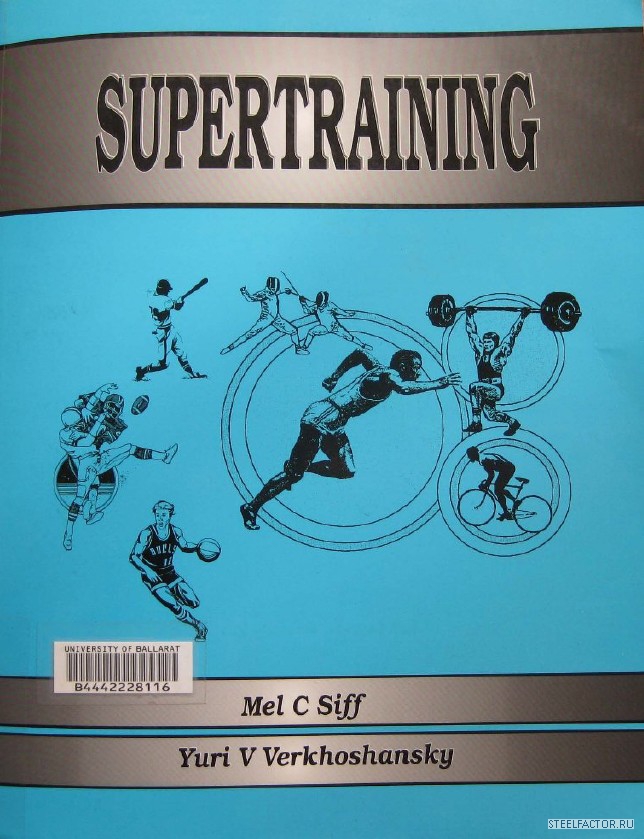
4th Edition, 1999
Paperback: 484 pages
Language: English
Book review:
Supertraining is one of best research and complete books on sports and exercise science. Its author, Dr Mel Siff is an amazing resource and has done a great job linking 'Western research' to that of the former Soviet and East German sports science laboratories. It is the type of book you need to sit down in a quiet room and only read a few pages at a time, and even then yo may have to read them a few times. It is very complex but truely a worthwhile read and belongs on the shelf of anyone involved in physical preparation - from rehabilitation right through to the highest sports endeavours.
This is what has been said about this best-selling strength training book which is already owned by many of the world’s top sports coaches and personal trainers:
"This is a book that has no equal! Nor is there a book that is even comparable to the extent and depth of the information presented. Supertraining belongs in the library of every athlete, coach, researcher, sports medicine doctor, trainer, and physical education and sports teacher. In essence, anyone who deals with an athlete should have a copy of this book.”
Dr Michael Yessis, expert on kinesiology and Russian training, and writer for numerous fitness publications.
Contents:
1. Strength and the Muscular System
1.1 Preliminary Issues
1.2 Fundamental Biomechanics of Strength
1.3 A Philosophy of Physical Training
1.4 Specificity in Training
1.5 Strength and Fitness
1.6 The Nature of Strength
1.7 The Muscle Complex
1.8 Classification of Muscle Actions
1.9 Cocontraction and Ballistic Movement
1.10 Types of Muscle Contraction
1.11 The Triphasic Nature of Muscle Action
1.12 Types of Muscle Fibre
1.13 The Mechanism of Muscle Growth
1.14 Neurophysiological Aspects of Exercise
1.15 Bioenergetics and the Energy Systems
1.16 Adaptation and the Training Effect
2. Special Strength Training For Sports Mastery
2.1 Schemes for Perfecting Movements
2.2 Specialisation to Develop Sports Mastery
2.3 Characteristics of Physical Fitness
3. Factors Influencing Strength Production
3.1 The Regimes of Muscular Work
3.2 Qualitative Characteristics of Strength
3.3 The Influence of External Conditions on Strength
3.4 Factors increasing the Working Effect of Strength
3.5 Flexibility and Sporting Performance
3.6 The Strength Matrix System
3.7 The Movement Matrix System
4. The Means of Special Strength Training
4.1 The Problem of Training Means
4.2 Electrical Stimulation for Strength Development
4.3 Dynamic Correspondence as a Means of Strength Training
4.4 Strength Training and General Endurance
5. The Methods of Special Strength Training
5.1 The Problem of Methods
5.2 General Principles of Special Strength Training
5.3 Application of Special Strength Training Means
5.4 The Principle Aims of Special Strength Training
5.5 Cross Training in Sport
5.6 Circuit Training
6. Programming and Organisation of Training
6.1 The Development of Training Organisation
6.2 Periodisation as a Form of Organisation
6.3 Training as an objective of Management
6.4 Prerequisites for Organising Training
6.5 Classification of Sports
6.6 Characteristics of the Training Process
6.7 Preparedness and the Training Load
6.8 The Long-Term Delayed Training Effect
6.9 The Dynamics of Training in the Annual Cycle
6.10 Principles of Programming and Organising Training
6.11 Primary Aims in Programming Training
6.12 Models for Structuring Annual Training
6.13 A Sequence for Programming Annual Training
6.14 Managing the Training Process
6.15 The Future of Programming Training
7. Strength Training Methods
7.1 Bodybuilding and Other Strength Training Methods
7.2 PNF as a Training System
7.3 Muscle Training
7.4 Use of the Strength Training Compendium
8. Designing Sport Specific Strength Programmes
8.1 Preliminary Considerations
8.2 Needs Analysis and Sports Modelling
8.3 The Training Programme.
8.4 Classification of Exercises for Sports Training
8.5 Overtraining
8.6 Restoration and Stress Management
8.7 The Use of Testing
8.8 Principles of Safety in Strength Training
8.9 Safety and Training Apparel
8.10 Safety and Machine Training
8.11 Protection by the Muscles
8.12 Towards the Future
References and Bibliography
От себя:
Написали эту книгу ныне покойные доктор философии Мэл Сифф, легендарный тренер американских чемпионов-силовиков, и доктор педагогических наук профессор Юрий Верхошанский, разрабатывавший победные тренировочные методики для советских тяжелоатлетов. Будучи впервые опубликованной в 1993 году, эта книга претерпела множество переизданий (в 2009 году вышло шестое издание). В каждом новом переиздании исправлялись ошибки и добавлялись данные новых исследований.
Этот фундаментальный труд обязателен к изучению каждым, кто интересуется научными основами тренировок с отягощениями. Книга не даст вам конкретных рекомендаций, какие упражнения делать, сколько подходов и повторений выполнять, зато она даст вам все необходимые знания для создания собственной оптимальной программы тренировок. Кому-то может показаться, что авторы слишком уж углубились в теорию, но для человека, способного разобраться в теории спорта, не составит труда воплотить теорию в практику. Надо отдавать себе отчёт, что данная книга является скорее не лёгким летним чтивом, а самым серьёзным справочным пособием по силовым тренировкам. Если, например, вам нужна информация по теме "Плиометрия", то вы просто находите в оглавлении соответствующую тему, читаете её, и после прочтения вы уже знаете всё, что может пригодиться вам как спортсмену или тренеру.
Качество представленного скана, мягко говоря, "не очень", но другого нет и пока не предвидится. Чтобы текст стал читабельным, нужно сделать zoom на 250-300%.
Скачать: http://rapidshare.co...pertraining.rar
 Наверх